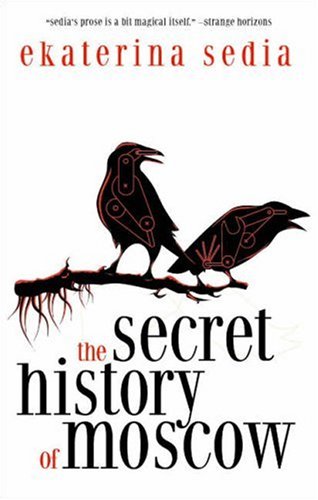
How I came to this book is through research. I am looking into the various creepy crawlies of various cultures folklore. I asked a friend that was raised in Russia about Russian folklore. She gave me The Secret History of Moscow by Ekaterina Sedia to read before we discuss it.
I have to admit that once I started this it was a page turner. It’s set in modern times but draws on the legend of pre-revolution and revolutionary Russia. Heck we even see Soviet Russian fall into legend.
The story is bleak much like what I’ve been led to believe is the traditional Russian outlook. I found it interesting to hear how the average person felt about the Soviet fall. Before the fantasy part comes forward in this urban fantasy we get a glimpse into post-Soviet Moscow.
The heroes and villains of the fantasy segment are all new to me and fascinating. I especially liked Koschei the Deathless. He was a very intriguing fellow. One-eyed Likho was intriguing and very creepy. Also the November Revolutionists Wife Marya Morevna was a more modern myth that was elegant and tough.
Overall the story was fast paced and kept me turning the page to see what happens next. The ending was very fitting for the story and we learn why people were turning into Jackdaws including the main character’s sister.
The only thing I found distracting was the over use of the ‘said’ tag. I noticed it early on and at times became distracted by it. Maybe it was an artifact of bad editing after translation. One of the first thing in writing is learning that said is dead in dialogue. There are many ways to indicate who is speaking. Often you don’t need to indicate but the flow of conversation between two will naturally do it.
I recommend this book to get a view from Russian eyes. It’s an urban fantasy that’s got a unique perspective this book is for you.
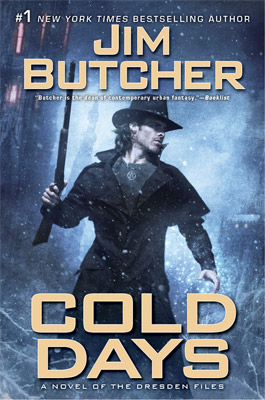
I discovered the Dresden files when he was on book 5 Death Masks. I liked it so much my next vacation at the beach I read books 1-4 in a week. I’ve kept up with them since then. I generally devour them the week they are released. I love the audiobooks too. James Marsters does a great job reading them except Ghost Story which was read by John Glover. Well Cold Days is book 17 and Ghost Story was book 16.
In the last book Harry was for all intensive purposes a ghost. Which was interesting but being in that state it took away one of his traits that I like so much – the ability to kick ass in any kind of fight. Yes when you are all wispy you can’t toss spells around or throw punches or use any weapons. So the fun underdog wins the battle part of the typical entry in the series was gone. **SIGH** I did miss it but in this book Jim Butcher made up for it by a final battle that was chapters long. I kid you not CHAPTERS long.
You see due to some technicalities Harry has his body back. Now he also is the human knight to the winter queen who happens to be the faerie Queen Mab of legend. She’s always been a terrifying presence on the edge of Harry’s life. Since the books are written in first person the only view we get of her and others is through Harry’s perspective. He’s always seen her as a malevolent character. Even at the start of the story when she’s personally over seeing his physical rehab by trying to kill him each day – she’s not seen as a wonderful benefactress. Yet as this story unfolds there are things we learn about her that make her more sympathetic. She has a large weight of responsibility to the real world both mundane and magic that Harry (and thus we) weren’t aware. Also in a private moment we learn the Queen like all fae folk was once human. Fae are born as halflings and have to choose which side they will take, just how or when the choice is usually made we aren’t told. We do see one halfling be forced into a side but it’s an extraordinary circumstance made by battle and insanity of courtly fae that sets up the situation.
I have to say I like glimpsing the magical beings but my heart lies with the magical humans like what Harry was when he was just a wizard. This story spends a good amount of time in the Winter Court in Never Never which is the magical realm occupied by the fae. Not my favorite setting in Dresden. I don’t mind the White Court, vampires in Chicago as much as I do the Never Never. I guess that’s because what brought me into Dresden was the concept of a wizard private investigator. We’re far from that now but the roots of seeing the magic world in the mundane is what I loved. I didn’t want to live all in magic in this urban fantasy – when we do it’s just fantasy and that’s way down my genre list from urban fantasy. I’m a picky reader I know but hey there is so much out there I have to be. Only so many reading hours per life ya know.
What I did enjoy in this book was the return of action. Dresden isn’t just his bad self again – he’s his bad self augmented by the Winter Knight mantel and Queen Mab’s daily attempted murder training sessions. So he can really kick ass as seen when the final battle rages for a quarter of the book. Ya know I kinda think Jim Butcher missed writing the action too. As much as I was glad to have it back, even I – the action glutton – thought this was a bit much. Still it was fun but didn’t touch reanimating Sue the T-Rex to ride her through Chicago to get to the big supernatural battle though. Nope that’s still my happy geek moment in the Dresden Files.
The other thing that was good to see back was Molly. She’s not the terrified, tortured, homeless waif we saw in the last book. Actually we learn why she was being trained so harshly by Harry’s godmother. Molly is now a not just a good wizard in her own right but a a powerful one. She works as a full team member without any issues on Harry’s part, except well the effects of the Winter Knight but I’ll let you discover that for yourself. To see the team back together – Butters, Molly, Thomas, Karrin, and Bob along with Toot-Toot!!! (I adore Toot-toot!) working together to solve all the emergencies that are colliding at the same time. It’s wonderful to see them and awesome to see the characters have grown.
That is why I’m okay that it’s not a series about a PI who is a wizard in Chicago any more. The characters out grew it. Every character including Bob have grown and changed given the stories that have happened and the time passed. That’s why I can keep coming back, it’s formula with growth. That’s why I don’t miss the PI stuff but I do miss Chicago. I want Harry back there not living off in fantasy land. That’s all.
I love how threads and points from earlier books are paid off here in this story. We learn more about Harry’s island Demonreach and what his role is with it. We learn why Harry’s godmother was frozen in Mab’s garden in a past book. We learn more about the Outsiders. More about the structure and nature of the fae’s courts. So it’s a big world expander that ties up some things.
All in all it took me a day and half to read, yes it was a page turner. I loved it and am left waiting at least a year to find out how the heck Harry gets out of being the Winter Knight without being a ghost for real the next time. I suspect Santa Claus and Demonreach will have a hand in helping him with this one. Yes you read that right Santa Claus – he’s the Winter King don’t ya know. Oh and he’s more if you read the subtle clues in the final scene where he chats with Harry after the huge battle. Hint – brush up on the pre-Christian origins of our jolly one in red.
If you’ve not been introduced to Dresden Files let me have the honor of highly recommending them. You can’t go wrong starting at the beginning in book or in audio book and working your way through. It’ll be an adventurous action filled ride that leaves you longing for the next one. I just warn you when you get here to book 17 Cold Days it’s gonna be a long wait for the next one -but it’s coming!
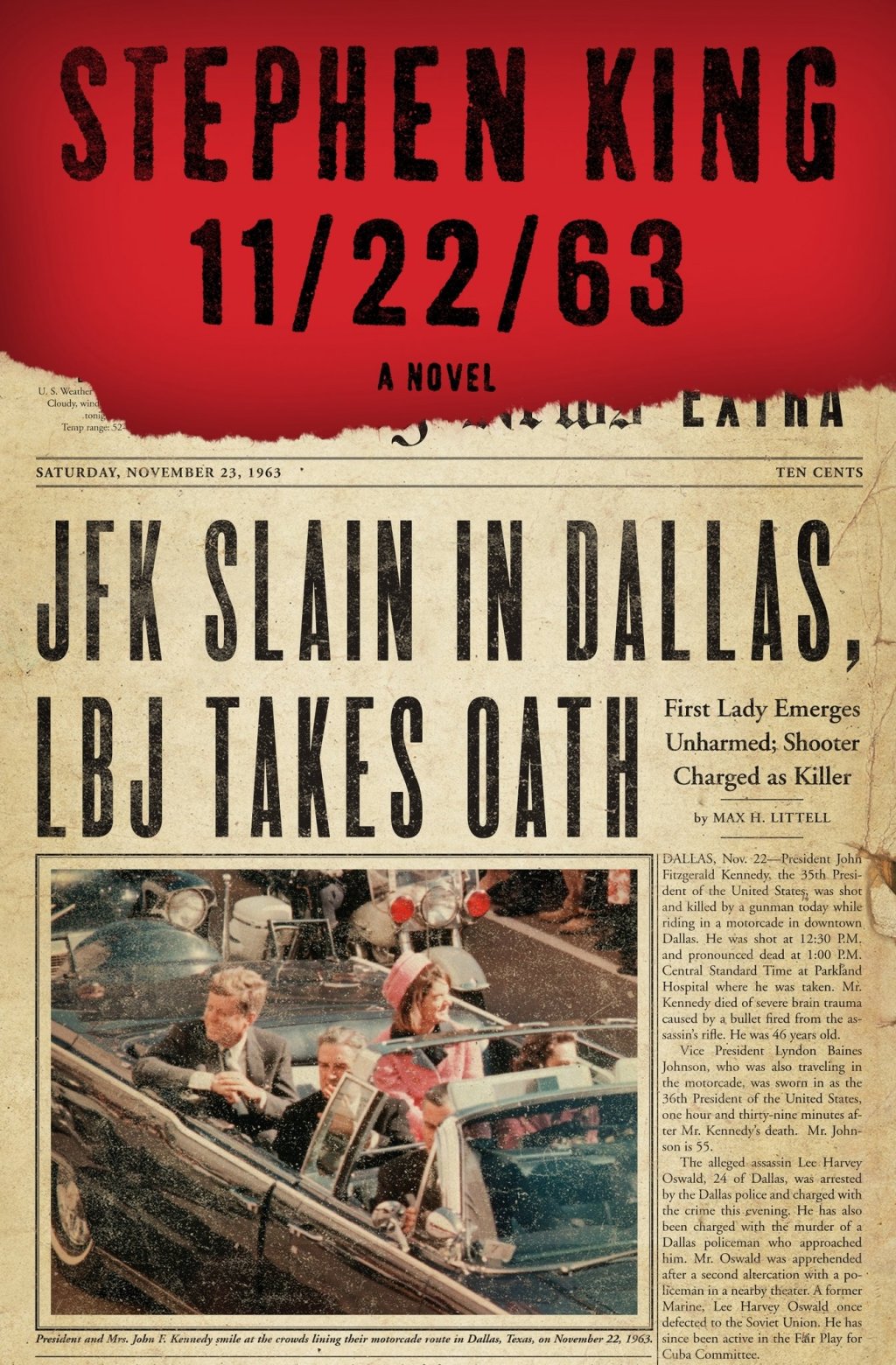
As I sat down to write this I thought who am I to review Stephen King a modern master of the novel?
As a writer, no one was the first answer. As a writer I study him for some of the best example of modern description. Short quick phrases that set the scene and help keep the action moving. He’s a master at it. I’ve heard it called Blitzkrieg characterization. How he moves from type of tone and genres in 11/22/63 is masterful. As a writer I’ve not got a leg to stand on and offer any judgement.
As a reader, I stand upon a mountain of books read over a lifetime of loving story. I’m in a strong position as a reader to comment on what I like and don’t like. I read multiple books at a time across multiple genres of fiction and non-fiction. So I figure I’m in a good place as a reader to offer my comments on King’s latest novel 11-22-63. It’ll be on that stance I’ll make comments.
11-22-63 left me in an odd place as a reader – I wanted more or less story. When I finished I was very unsatisfied despite it being a long 849 pages. This story blends genres. It’s publicized to be about going back in time to attempt to stop the assassination of Kennedy. Along the way to the point of the story it visits the territories of sci-fi, horror, alternate history, and romance. I’m not against blending genres but the only one I thought that got a full story arc was the romance, the other aspects of the story were left feeling unfinished for me.
I’ll be the first to admit as a reader the genre of this blend I like the least is romance. I loved it as a teenager but my taste changed. So during the pages of romance and lyrical waxing on the two lovebirds jitterbugging – I was bored, bored, bored and wondered when the heck were we going to return to the sci-fi of time travel, or the horror of the It creature, or start the alternate history of interfering with Oswald? Instead I was stuck in an overly sentimentalized non-existent Texas town reading a romance.
As for the sci-fi part I wanted to know more about Al, the man who discovered time travel and developed the mission the main character Jake/George carries out. I wanted to see how the rules were figured out by Al. I wanted to know more about his diner’s relationship with the phenomena he found. I was frustrated because King broke the first rule – don’t tell show. We were told the rules of time travel and I wanted to see how they were discovered.
As for the horror part I liked the references to the It creature by starting the story out in the middle of the It story. Having read the novel long ago I recognized Pennywise and a few of the characters in the town. Carrying Pennywise forward in the story and linking him with the assassination by suggestion was great! I wanted to know how this dark force was related to Oswald! But alas that thread was never completed. I liked how it was going but once the event of interfering with the assassination started that was pushed aside and forgotten. I closed the book thinking – so what the hell did Pennywise have to do with it? Was it just pages and pages of a distraction?
Then there’s one of my favorites – alternate history! I thought surely with a book about time travel to stop with the Kennedy assassination I’d get some alternate history either way the mission went. If Jake/George is successful or not he’s change history in many ways waiting out the years to get to the event, just like Al had to change it in his discoveries. Just like the green card man explained to Jake/George (a second case of telling NOT showing). As a reader I got a glimpse of what the mission did to the future but not HOW it did it in the third case of telling not showing. The bulk of the book was eaten up by getting to the assassination and the ending was rushed. The alternate history was short changed. I didn’t get to live the world after the interference with the main event, the whole thrust of the plot – instead I glimpsed it and was told the payoff that I’d waded through 100s of pages of romance to see.
Finally the fatal flaw for me was Jake/George’s supposed worry about effecting history before the event? Heck you are setting out to change a lynch pin event in history who cares if you start that change a few years earlier? You are changing ALL OF TIME AFTER THE INTERFERENCE FOR ALL ETERNITY what does a few years, heck decades, heck even centuries matter? There’s eternity on the other side of the mission! Unknown-illions of lives from 1963 to the end of time shifted – what’s a few billion changed for less than a decade matter in balance with that? His reasoning doesn’t make sense. Sure it’s fun to stalk about the edges of Oswald’s life for years but that’s not why I picked up the book. I picked up the book on the promise of time-travel interfering with the Kennedy assassination and for me what happens after that.
I also didn’t pick up the book to read an idyllic look at small town America in the late 50s early 60s. I felt the touching on the social ills was there just to give a nod to the modern reader. Yeah I know it was a time when women weren’t liberated, black were segregated, and domestic abuse wasn’t seen as a police but rather a family matter. After a few periphery nods he goes on with the almost “Leave It To Beaver” tone of the story. Sure there are dark events but they all pull together, have a talent show, and deal with them as a white happy community! I choked back my barf and pressed on hoping for more time travel mission.
When I closed the book I spent a long time thinking about why I felt disappointed as a reader. What would have made me happier with the story – the answer was an odd one. Either make it a series of books covering Al’s adventures through Jake/George through the alternate history and end with Jake/George telling us how it ended. So one answer was give me more so I’m not left hanging on these issues that felt unfinished. Second sell it as a romance with some time travel mission to it and cut down the first part of the book. Third keep it as a time travel book cut Pennywise, romance, and tighten the focus. Fourth make it a pure genre not a blend. King’s best books have been that way in my opinion as a King reader.
So as a reader I walked away with too many questions to call it a great read, it was a good read. As a writer I’ve learned look for plot holes have beta readers look for unanswered questions, know when to cut threads out if you can’t tie them up at the end. I think my biggest lesson as a writer is that genres exist to satisfy the reader – so that the book has focus and the reader can get the full story. Successful blending of genres means you answer all the plot elements you raise be they sci-fi, horror, alternate history, or romance.
In the end I’d quiz someone about what are they looking for in a read before I’d recommend they open this book. It has a lot to offer as most stories by masterful writers do – but it’s not perfect.
Word count – something you hear a lot about once you delve into writing. There’s NaNoWriMo where the goal is 50,000 in a month no matter what. Books on wriitng talk about daily goals in word count. Publishers call for pieces by word count. Publishers often state pay by the word. When writers talk about how their writing day went it’s in word count. So yeah, in writing, word count counts.
As a newbie I struggled with this concept. On one hand it’s not hard for me to churn out 3,000 words a day. Then on the other hand I tend to ramble, those aren’t sellable words they’d be edited down to say 1,200 or so. Part of my growth as a writer was coming to terms with word counts and using them productively. The hardest writing isn’t getting big numbers but saying what you want to say in small numbers. Writing short is the hardest. Mike learned that this weekend when a 500 word paper took him 16 hours to write, where as 3,000 word paper on the topic would have been easier.
Why Count? Words Per Page
First let’s look at why word count is the industry standard of measurement. Printing isn’t cheap. The expense of making a paper book is a major investment by the publisher. Depending on font size, layout design, and type of book the word count varies from 250 per page for large print books to 1,000 per page for pure reference books. Novels fall about 350 – 400 words per page. Sure this is going to change given ebooks. But then again just how that will be is still up in the air, the market is still hashing that one out. Right now if you want sale success like Harry Potter, Twilight, and 50 Shades (and honestly what writer doesn’t?) printed paper books are a driver in sales and a marketing tool. Word count is a measure of printing expenses that the publisher is ask to bear up front.
What’s a short story word count? What’s a novel?
The next question that arises is how many words in a novel? The typical answer is 75,000. That’s a good median number across genres. The truth is NaNoWriMo is short even for the lower end of the genre scale. I’ve read many blogs by very successful agents and editors all agree the kiss of death is to fall outside the industry accepted range for your genre. Every type of book has what’s expected in word count driven by printing concerns and audience preference for length (we’ll get back to this idea) be it a children’s book, young adult, fiction or non-fiction there are industry ranges.
I mostly deal in fiction. I’ve sold short stories and I want to sell novels. The short stories I’ve sold have fallen 3,000 – 5,000 words, the industry guidelines for shorts ranges from 1,000 – 7,000. So my experience has fallen right in the middle of that. Steampunk gets a large word count than say noir mystery because of the genre tropes. This concept carries over to novels too. Depending on the genre word counts for novels vary widely. On the low end are cozy mysteries and category romances these can be as low as 55,000 but no higher than 80,000. The high end is high fantasy and literary running 80,000 – 200,000. I tend to write mystery, thriller, or crime type of stories those fall again in the middle 75,000 – 90,000.
These aren’t set in concrete and are hazy at the ends so do some research reading several agent and editor blogs to get an idea of your specific market. Also if you are writing to a contract, hold to the requirements do NOT exceed or fall short. Second if you are writing or submitting to a call – meet their guidelines it’s one of the first ways they thin their pile is tossing out the too short and the too long without reading them.
What drives these counts for different genres?
Also consider your sales record as a writer when setting out your word count goals. Let’s face it, proven best selling authors get carte blanche almost when it comes to word length. Just look at Stephen King’s The Stand or the advancing size of J K Rowling’s Potter novels to see it in action. If either of them hadn’t had millions if not billions of sold books under their belts and proven best sellers on release day those books would have been much smaller. For first time writers writing within the call and guidelines is the best, don’t push either end of your chosen genre’s limits.
Another word about these guidelines for novels, they are always in flux. Reader preferences as well as printing expense drive them. What a modern reader generally reads for is action and experiences. Where as the Victorian reader read for description. Think about that for a minute. If we want to know what it is like in India we hop on the internet and see pictures, documentaries, articles, chat with people in India and maybe even book a trip there. It’s easy for us to see it virtually or in real life. Not so much so in Victorian times, they couldn’t do that. Photographs were new and expensive. Travel was expensive, arduous, and rarely for great distances. Printing was affordable so they read to ‘see’ what new places were like. Today we can easily see a place now a reader reads to experience things he can’t. It might be a thriller or might be another life in an exotic place.
These preferences drive word counts. steampunk, fantasy, science fiction readers read more for the life in an exotic place reasons these take more descriptive scenes. Description takes more words than action. So these get higher end word limits. This even showed true going to my short story experience. On the other hand – mystery, police procedural, thrillers all take place in a world we know but the reader is there for the action. So those have lower limits, the writer doesn’t have to establish the world- it’s already there and the reader knows it.
Do chapters have word count guidelines?
We’ve talked about page word counts. We’ve talked about total story word counts. What about chapters? If you thought the other was kind of fuzzy, chapters are totally blurry. There are lots of avenues of thought on this. Some will say let the chapter breaks fall naturally where they may as long as you are in the guidelines total limits good! Others will say 2,500 to 3,500 words per chapter for action based stories and 3,500 to 7,000 for more world building stories. Others will favor ending the chapter on a hook or cliff to pull the reader forward into the story.
I listened to all the pros and cons of the stances on chapter lengths. I then went to the library and looked over chapter sizes in best sellers in the genre I aspired to write. I also looked at how each chapter ended. Was it with a hook, a cliff, or end of scene or mixture? I also thought about myself as a reader. What chapter types did I like to read in this genre? I realized I often say to myself – I’ll read to the end of the chapter then I flip to see how many pages that is. If it’s a lot of pages I don’t and stick my bookmark in it then go off to the next thing. If there’s just a few I’ll read on. Same about the ending. If it’s end of scene I’ll put the book down. If it’s a hook or cliff I’ll look at the next chapter’s length and if it’s not too long I’ll keep reading.
Finally I talked to authors. Not newbies like me but experienced ones. Ones that have had best sellers. Ones that have multiple novels published. Ones that have had multiple books published not only in various genres but in both fiction and non-fiction. I came away with several things. The first important one was stressed over and over – stay within the overall guidelines. Second it’s easier when planning and writing to set word count expectations for chapters. Thirdly I had several in my genre say that their writing went faster when they accepted the idea that chapters end with a hook or cliff as well as the 2,500 to 3,500 word count guideline. Also a few noted that with planning and those guidelines their amount of proofing/rewriting time dropped drastically. So given what I saw published, what I like as a reader, what experienced well published authors were telling me – I settled on those as my guidelines. Ya know what? That USA Today best seller knew what she was talking about! It is easier to write and plan with those in place.
Word counts count if you decide they do.
In the end it comes down to why you write in the first place. Are you writing to sell? If so then yes they count. They determine if an agent or publisher looks at your manuscript. They determine your pay. They effect the style and structure of your story. They are driven by the market both aspects economic and customer preference. IF your are writing to sell then do your research know what is expected and meet those expectations.
IF you are writing for enjoyment – yours and your friends/family. Then no, they don’t count. You don’t have to worry about how many words you have any where. If you fall here don’t worry just tell your complete story well and enjoy.