Tag: Waukegan

  • Restored Home in Waukegan

    Restored Home in Waukegan

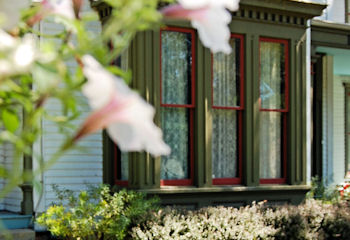
    Victorian home painted in a goldenrod, trimmed in olive green and red, porch ceilings painted sky blue

    Now we return to our Waukegan Trip.  The Haines Museum in Bowen Park opened and we got to tour it.  It’s operated by the Waukegan Historical Society.   This home was originally built as a one room cabin to go with the farm that is now Bowen Park.  Over the years with various owners it was added onto it until it because the Victorian home you see now.

    Mayor Hull of Chicago and his family lived there as their summer home until the great fire then lived there full time.  I learned that back then there were yearly elections for mayor.  CAN YOU IMAGINE YEARLY ELECTIONS? Always being bombarded by the campaign trail, all the calls from the various parties and interests groups.  The constant ads… it’d never end.  The mayor would never be a leader but a figure head and it’d open up for another machine that stayed in tact to actually run the city.  Oh wait… that’s what happened in the Chicago Political Machine.
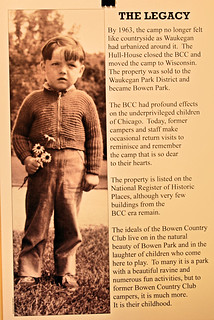
    Information poster shows a young boy from the 30s in a zippered sweater and dungarees holding a small bouquet of wildflowers

    Okay back to the house, it’s restored to its Victorian period to go with the architecture.  It was the center of the Bowen Country Club.  Here is where the children would be taught the ways of society.  It was thought part of the barrier of improving oneself was not understanding the societal  norms of table manners, dances, polite conversation, etc.  I think honestly some that still holds true today knowing how to behave in the boardroom as well as the local bar is key to advancement. Today there is a room dedicated to the club and those kids it helped in so many ways not just the social graces classes in the house.

    None of the items in the house are from the original owners.  They are from the correct time period and exemplify the types of things the home would have contained in this 1870s time period.  The last addition was the red parlor, a more formal parlor, and the master bedroom.  The master bedroom now contains a bed and settee set that Abraham Lincoln used during his visit to Waukegan.  The room is dedicated to him.

    Servants entrance with will worn torn screen door and dirty clapboard, still painted red

    There were exhibits to the Waukegan area residents Alfred Gustafson and James Elsbury who died on the Titantic.  There was an exhibit honoring Waukegan son Jack Benny, which explained why there was a Jack Benny art center (where the unhelpful lady was).  There was also a time line of Waukegan events including when their town got curb side recycling!  YAY!  From there I’ve added the Genesee Theater as a place I want to visit for a photo post.

    Also I noticed that all their doors were painted red.  I had to get photos of each one to add to my red door collection!  Heck some day I might make a poster of doors to sanctuary – all red doors I’ve photographed.  I have to say of all the doors my favorite one on the Haines Museum was the servant’s door with the aged screen.  Some doors to sanctuary aren’t ornate but are well used.

    Enough explaining – now for the photos.
    (more…)

  • Heading to the Park That Took Years To Become a Park

    Heading to the Park That Took Years To Become a Park

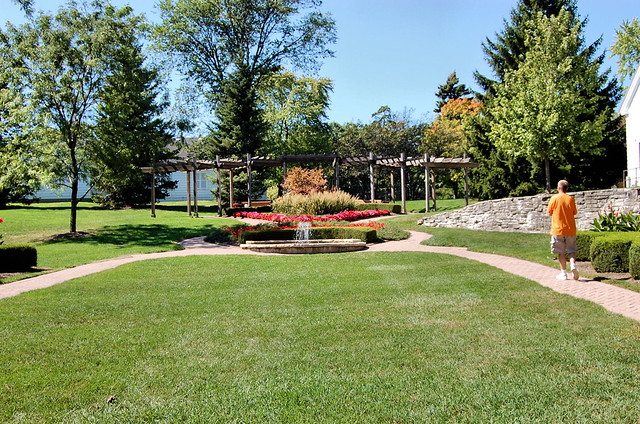
    flower gardens around a small fountain leading up to a pavilion

    Last photo post left you on the Road To No Where also known as the Amstutz Expressway or IL-137.  We were on the odd road heading to Bowen Park in Waukegan.  We’ve commented on the park for years as we’ve passed.  It’s restored Victorian house up front, the rolling hills and gardens, the use of its other building and sporting facilities have always caught our eye.  We’ve talked several times of going down there to see just what it offered and touring the house.  That was our agenda this Saturday before the University of Tennessee versus Florida game.

    poster of Jack Benny in his classic distressed hand on face pose
    Oh my, she wasn’t much help.

    We pulled in and weren’t sure where to begin.  He headed down to the Jack Benny Arts center.  There it appears they have a place for the performing arts.  However we weren’t to learn much about the place.  The lady behind the counter wasn’t very helpful and seemed put out that we didn’t know how the park operated.  She kept her arms crossed over he chest the whole time, dismissed the idea there was more to tour than the house as if seeing well kept historical buildings and a museum sign didn’t suggest that maybe all were open.  She didn’t offer to explain what the art center was or if there was something to see there.  After struggling to get any useful information we learned the house was the historical societies and opened in twenty minutes.  With that she turned her back to us to tend the stack of mail.  Being so dismissed we wandered out into the sunny day and beautiful landscape.

    What we learned wandering, reading plaques,  and later from the helpful AND friendly historical society gentleman was that Bowen Park park has long been a park.  Originally it was purchased by a family from New York City and was a farm for years.  Then a Mr. Buck purchased the place, he was a forward thinker and wanted to designate the area as a park preserve for the town of Waukegan. Now the town thought this was strange because this was just a farm out in a large swath of farmland between Waukegan and Chicago.  We’re talking pre-Civil War era.  However Mr. Buck was convinced that an area needed to be preserved because the growth of both would one day meet and such areas would be needed.  However, his idea didn’t fly.

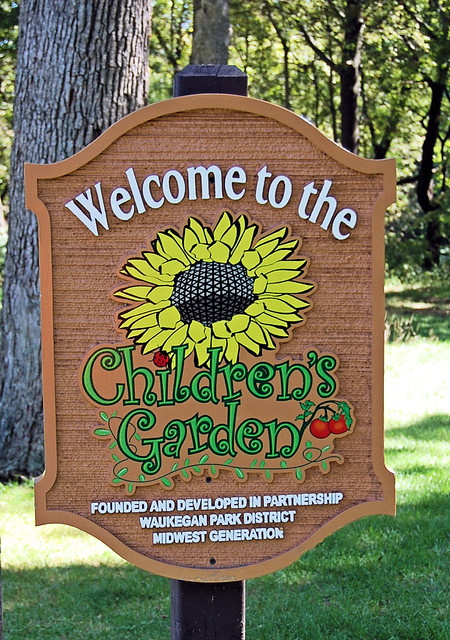
    Sign before an area of raised gardens that were planted by children groups

    It was then purchased by a Chicago Mayor and his wife. Well they used it as a summer home to get out of the heat of the city until the great fire.  Then while Chicago was rebuilding they lived there full time.  Along the way it was owned by Louise Decoven Bowen was a Decoven of the affluent Decoven of Racine, live here long enough you get to know the names.   Upon her husband’s death she thought it’d be nice to bring underprivileged children from Chicago out to the country to get fresh air, do outdoor play, and learn things to help them get ahead in society. She’d spent years working with such families and saw the need for the children.  The Bowen Country Club was born.  Not a Country Club like we think of but club in the country for underprivileged children to get out of the sooty city and enjoy the countryside.  The land was converted from farming to this park use.  That’s really when the root of the park design started.  The idea was Buck’s, the basis was Bowen.

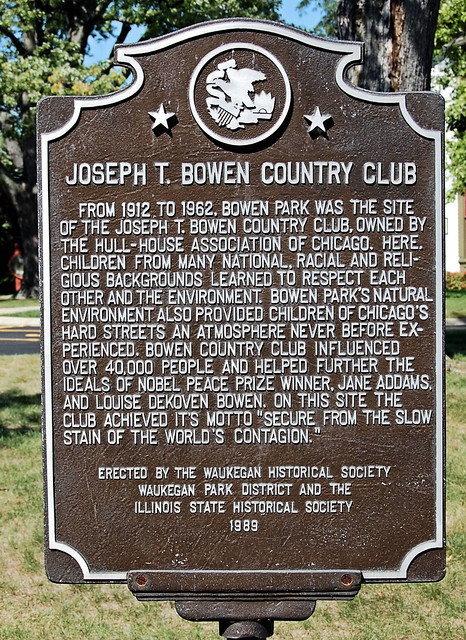
    Joseph T. Bowen Country Club, From 1912 to 1962, Bowen Park was the site of the Joweph T. Bowen Country Club, owned by the Hull-House Association of Chicago.  Here Children from many national, racial, and religious backgrounds learned to respect each other and the environment. Bowen Park’s natural environment also provided children of Chicago’s hard streets an atmosphere never before experienced.  Bowen country club influenced over 40,000 people and helped further the ideals of Nobel Peace Prize Winner, Jane Addams and Louise Dekoven Bowen.  On this site the club achieved its motto “Secure from the slow stain of the world’s contagion.”  Erected by the Waukegan Historical Society, Waukegan Park District and the Illinois State Historical Society 1989.

    This club officially ran from 1912 – 1963.  That was when the dorms and cottages were finished and opened.  Before them she hosted small groups in her home and out buildings.  When the club closed the land was converted to a park for Waukegan.  By then Mr. Buck’s idea didn’t seem so odd.  The growth of Chicago and Waukegan proved to meet as he had predicted and this was a green gem in  middle of them.

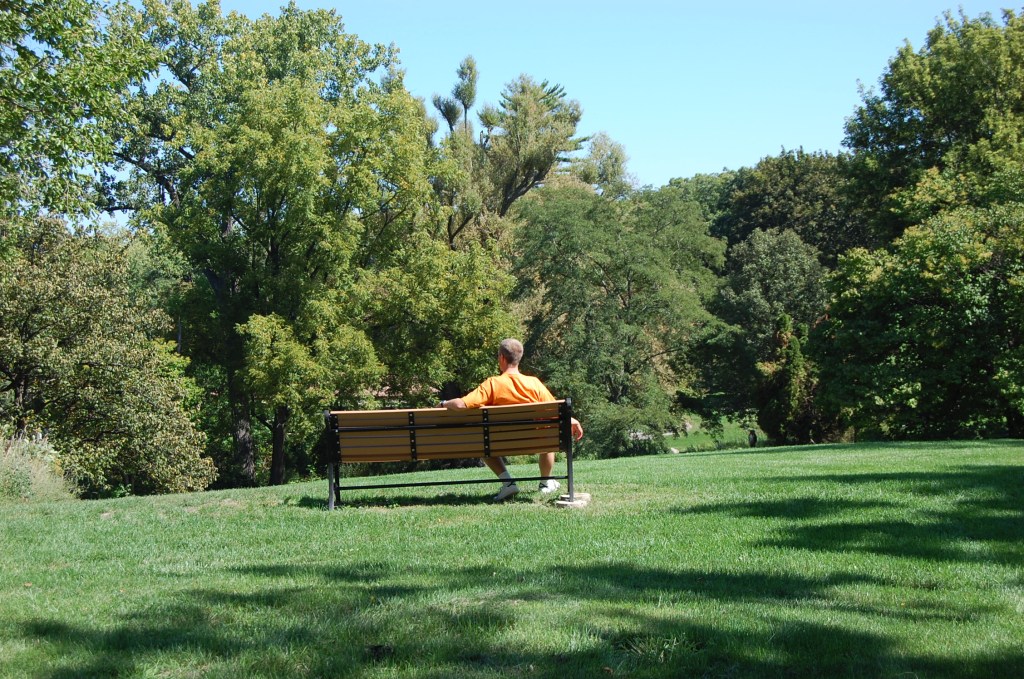
    Today many of the buildings from the Country Club are still used for various activities.  The Lilac Cottage houses a library and class rooms for the arts.  Other buildings serve as offices for the park department or historical society.  It’s still a place to get away from the city and enjoy the land. Judging from the children’s garden we found it’s still a refuge that caters to children. We eventually sat down on a bench and listened to the drumming circle.  We watched children enjoy rolling down a little hill in front of us while a family set up a pavilion for their family reunion that day. All in all I think Mr. Buck and Mrs. Bowen would be pleased by the park’s usage today.

    (more…)