I hate excuses. I love reasons. Sometimes reasons are used as excuses. I think that’s what I’ve been doing about blogging. You see there were good reasons for the disruption to my routine with all the trauma of last month. I tend to cope with such things by battening down the hatches, pulling inward and getting through. I did that. I’m through and emotionally I’ve dealt with it all.
However I’ve not returned to my 5 days a week blogging. I intend to but well reasons became excuses and I languished in the new/old habit of not blogging. Except for that nagging desire, that I want to to it. Yet we all know inertia is hard to overcome or establish. Yes just as a moving blogging truck is hard to stop, a blogger at rest is tends to stay at rest. I hope to muster the energy to overcome the rest and build my blogging inertia.
Energy, I have to admit it is something I have always struggled to get, use wisely, and not exhaust totally. Still learning what is my best pace. Seems just when I get a handle on it, circumstances shift. It doesn’t help I have the desire to do the work of 100s and the energy of half of one… LOL!
All this is to say, I’m sorry I’ve not been here regularly as I was. I long to be and am working how to do that while doing all the other things I want to do too. The latest challenge is the month of the June. At my work this is our big year making month. I know most retail industries it’s December but for us it is June. Don’t ask I won’t explain as my job is beyond the scope of this blog. However, it is where I go during Real Life and will be demanding more of time in the next month. My part time job will become full time then go back to part time again. I hope to balance that with getting back in the blogging groove.
Maybe my best bet is to start with small goals – a post a week at least. If I do more GREAT! Exceeded my goal. I just get one GREAT! Reached my goal! That way I don’t think nope can’t write five posts now so what’s the point? I believe in times of struggle or need to move to a goal, set yourself up for success. Sure I pretty much know I can do ONE post a week but you see feeling successful builds energy that I can put toward making inertia of blogging that will help me reach my big goal of 5 posts a week. So until July it’s a goal of just write one and go from there.
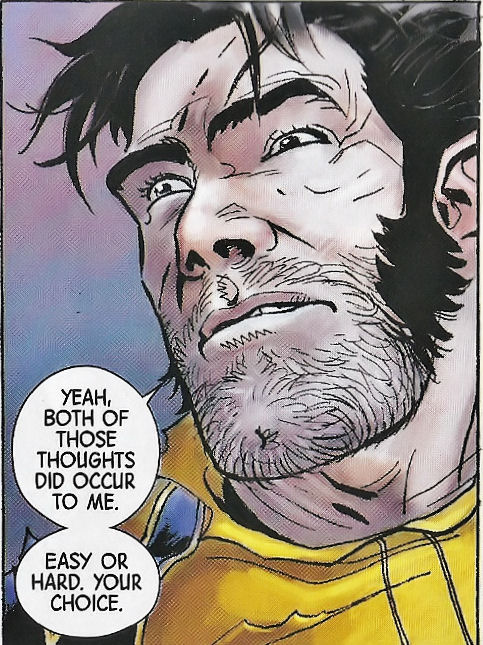
Fear Itself – Wolverine, Issue 3. Writer Seth Peck, Penciller: Roland Boschi, John Lucas, Colorist: Dan Brown Letterer: Jared Fletcher Orig. Published: by Marvel on September 07, 2011
I started doing Comic Comments just to share my thoughts about a comic with other comic readers. Kinda like chatting about a movie at a fast food joint after seeing it. Not a true review of the comic but more just commenting on it from my reading. If it’s working or not is hard to tell because I don’t get many comments back (apparently I’m sitting alone at a table chatting about the comic I just read) and very few e-mails. However it’s new and my inner voice says, keep your head down keep doing the column for a year THEN start to evaluate it.
Like all writing it’s developing organically, creating its own form just like characters and stories do as you work on them. The number of scanned pages has dropped. The legal statement has to be done. The shape has taken on a formula for now of intro, legal, creative team, discussion, few scans with comments. Seems to work for me right now but I’m running into some trouble defining just what I want the discussion to be.
I’m leaning more toward a review. I’ve been looking about at comic reviews and find there are basically three types – summary, cheerleader, critic.
The summary one retells the story of what happened in the comic. This is an easy one to fall into for me. It’s the sharing of my love for this style of storytelling that inspired the whole column to begin with. I want to share what’s going on with the title! However, a commentary or review isn’t about retelling the story. It’s to discuss the story with those who have read it or inspire someone to read it and then discuss.
The cheerleader one goes against my basic kvetching nature. Also if every comic book you read is yippeee-skipee wonderful great. I have to wonder about you more than the books. Trust me, comic book fans love to complain. If you are all rainbows, sparkles, and unicorns something’s up. I’ve come to the conclusion they are brownnosers. Why? maybe freebies from the big publishers, maybe promoting a friend’s indy, maybe just too Mary Sue to say what they really think, maybe secretly it’s the creative team doing the review (has happened in novels). I don’t know, but if all your articles on comics are rosy then I’m suspicious.
There there’s the critic or overly critical or a troll or just plain bitchy. This is the flip side of the cheerleader. Doesn’t matter what the title does it stinks. Sure there are occasional books that just plain stink even more rarely a whole title that stinks. These are few and far between. Publishers don’t invest money in actually printing if it is crap. Usually the art or the story will be a bright point in a book, sometimes it’s a matter of taste of if it went well. I can appreciate something that’s not my taste but well done for the genre it is. For example I’m not into Anime but I can tell great Anime when I see it – it’s just not my bag.
I try to strike a balance in my comments not reveal too much, not be overly approving or overly critical. I know I don’t always succeed. Sometimes I do. I’m not sure where the column is going, more toward review, summary, critique, or fangurling. I think it’ll waffle for a while longer while I find my Comic Comments voice. The one thing I do know is I’ll keep doing it. I enjoy it. It’s a labor of love. I don’t have anyone here in real life to share this interest with so I reach out here and occasionally get nods and emails from other comic book readers. Maybe I might even interest someone in picking up a comic now and again to look at it with a different eye than before. Heck if I can do that I think it makes it all worth while.
Next time I promise I’ll be back with a comic in tow to share. However if you can offer any input on how you see this thing going and what you as a reader want to see it do I’d love to hear it. Like Logan says your choice! Until next time peeps.
Word count – something you hear a lot about once you delve into writing. There’s NaNoWriMo where the goal is 50,000 in a month no matter what. Books on wriitng talk about daily goals in word count. Publishers call for pieces by word count. Publishers often state pay by the word. When writers talk about how their writing day went it’s in word count. So yeah, in writing, word count counts.
As a newbie I struggled with this concept. On one hand it’s not hard for me to churn out 3,000 words a day. Then on the other hand I tend to ramble, those aren’t sellable words they’d be edited down to say 1,200 or so. Part of my growth as a writer was coming to terms with word counts and using them productively. The hardest writing isn’t getting big numbers but saying what you want to say in small numbers. Writing short is the hardest. Mike learned that this weekend when a 500 word paper took him 16 hours to write, where as 3,000 word paper on the topic would have been easier.
Why Count? Words Per Page
First let’s look at why word count is the industry standard of measurement. Printing isn’t cheap. The expense of making a paper book is a major investment by the publisher. Depending on font size, layout design, and type of book the word count varies from 250 per page for large print books to 1,000 per page for pure reference books. Novels fall about 350 – 400 words per page. Sure this is going to change given ebooks. But then again just how that will be is still up in the air, the market is still hashing that one out. Right now if you want sale success like Harry Potter, Twilight, and 50 Shades (and honestly what writer doesn’t?) printed paper books are a driver in sales and a marketing tool. Word count is a measure of printing expenses that the publisher is ask to bear up front.
What’s a short story word count? What’s a novel?
The next question that arises is how many words in a novel? The typical answer is 75,000. That’s a good median number across genres. The truth is NaNoWriMo is short even for the lower end of the genre scale. I’ve read many blogs by very successful agents and editors all agree the kiss of death is to fall outside the industry accepted range for your genre. Every type of book has what’s expected in word count driven by printing concerns and audience preference for length (we’ll get back to this idea) be it a children’s book, young adult, fiction or non-fiction there are industry ranges.
I mostly deal in fiction. I’ve sold short stories and I want to sell novels. The short stories I’ve sold have fallen 3,000 – 5,000 words, the industry guidelines for shorts ranges from 1,000 – 7,000. So my experience has fallen right in the middle of that. Steampunk gets a large word count than say noir mystery because of the genre tropes. This concept carries over to novels too. Depending on the genre word counts for novels vary widely. On the low end are cozy mysteries and category romances these can be as low as 55,000 but no higher than 80,000. The high end is high fantasy and literary running 80,000 – 200,000. I tend to write mystery, thriller, or crime type of stories those fall again in the middle 75,000 – 90,000.
These aren’t set in concrete and are hazy at the ends so do some research reading several agent and editor blogs to get an idea of your specific market. Also if you are writing to a contract, hold to the requirements do NOT exceed or fall short. Second if you are writing or submitting to a call – meet their guidelines it’s one of the first ways they thin their pile is tossing out the too short and the too long without reading them.
What drives these counts for different genres?
Also consider your sales record as a writer when setting out your word count goals. Let’s face it, proven best selling authors get carte blanche almost when it comes to word length. Just look at Stephen King’s The Stand or the advancing size of J K Rowling’s Potter novels to see it in action. If either of them hadn’t had millions if not billions of sold books under their belts and proven best sellers on release day those books would have been much smaller. For first time writers writing within the call and guidelines is the best, don’t push either end of your chosen genre’s limits.
Another word about these guidelines for novels, they are always in flux. Reader preferences as well as printing expense drive them. What a modern reader generally reads for is action and experiences. Where as the Victorian reader read for description. Think about that for a minute. If we want to know what it is like in India we hop on the internet and see pictures, documentaries, articles, chat with people in India and maybe even book a trip there. It’s easy for us to see it virtually or in real life. Not so much so in Victorian times, they couldn’t do that. Photographs were new and expensive. Travel was expensive, arduous, and rarely for great distances. Printing was affordable so they read to ‘see’ what new places were like. Today we can easily see a place now a reader reads to experience things he can’t. It might be a thriller or might be another life in an exotic place.
These preferences drive word counts. steampunk, fantasy, science fiction readers read more for the life in an exotic place reasons these take more descriptive scenes. Description takes more words than action. So these get higher end word limits. This even showed true going to my short story experience. On the other hand – mystery, police procedural, thrillers all take place in a world we know but the reader is there for the action. So those have lower limits, the writer doesn’t have to establish the world- it’s already there and the reader knows it.
Do chapters have word count guidelines?
We’ve talked about page word counts. We’ve talked about total story word counts. What about chapters? If you thought the other was kind of fuzzy, chapters are totally blurry. There are lots of avenues of thought on this. Some will say let the chapter breaks fall naturally where they may as long as you are in the guidelines total limits good! Others will say 2,500 to 3,500 words per chapter for action based stories and 3,500 to 7,000 for more world building stories. Others will favor ending the chapter on a hook or cliff to pull the reader forward into the story.
I listened to all the pros and cons of the stances on chapter lengths. I then went to the library and looked over chapter sizes in best sellers in the genre I aspired to write. I also looked at how each chapter ended. Was it with a hook, a cliff, or end of scene or mixture? I also thought about myself as a reader. What chapter types did I like to read in this genre? I realized I often say to myself – I’ll read to the end of the chapter then I flip to see how many pages that is. If it’s a lot of pages I don’t and stick my bookmark in it then go off to the next thing. If there’s just a few I’ll read on. Same about the ending. If it’s end of scene I’ll put the book down. If it’s a hook or cliff I’ll look at the next chapter’s length and if it’s not too long I’ll keep reading.
Finally I talked to authors. Not newbies like me but experienced ones. Ones that have had best sellers. Ones that have multiple novels published. Ones that have had multiple books published not only in various genres but in both fiction and non-fiction. I came away with several things. The first important one was stressed over and over – stay within the overall guidelines. Second it’s easier when planning and writing to set word count expectations for chapters. Thirdly I had several in my genre say that their writing went faster when they accepted the idea that chapters end with a hook or cliff as well as the 2,500 to 3,500 word count guideline. Also a few noted that with planning and those guidelines their amount of proofing/rewriting time dropped drastically. So given what I saw published, what I like as a reader, what experienced well published authors were telling me – I settled on those as my guidelines. Ya know what? That USA Today best seller knew what she was talking about! It is easier to write and plan with those in place.
Word counts count if you decide they do.
In the end it comes down to why you write in the first place. Are you writing to sell? If so then yes they count. They determine if an agent or publisher looks at your manuscript. They determine your pay. They effect the style and structure of your story. They are driven by the market both aspects economic and customer preference. IF your are writing to sell then do your research know what is expected and meet those expectations.
IF you are writing for enjoyment – yours and your friends/family. Then no, they don’t count. You don’t have to worry about how many words you have any where. If you fall here don’t worry just tell your complete story well and enjoy.
Night fall, my Muse will be here soon to wake me up.
In the last few weeks I’ve gotten up at 3am to write. Why because suddenly my muse was talking to me. I saw a chapter, a post, a short-story – complete in total being read to me as if I’d downloaded it off Audible. I could see it all in front of me. My reader’s ear could hear it being spoken. Heck if it was a post I even saw what scans/photos I wanted in it and the format.
It’s not that I didn’t try to do this during the day. My life is now such that I can work during the day from 9-5 at home on my computer writing. I have a wonderfully supportive husband. My son is now old enough to take care of himself. I don’t have a job outside the home. I am free to write that novel, develop that website, and do those things. I am ever grateful to be blessed with such opportunity. It suits my health and I’m following my dreams.
Okay I’ve had that Ace Frehley ear-worm from the commercial that ends with it. Don’t know the product, a car of some short but enjoy the songs for where they are as they go across country. Not a good commercial for the car great one for songs, like Back In The New York Groove.
Life has been busy with Life stuff. Again dealt with health issues but again I’m back.
Decided to move my comic book review to this blog rather than on G+ so I can put the scans with the comments about the book. Getting my first posts on those ready.
Been working on some writing projects and dealing with over 100F weather.
Honestly I keep hoping a routine will establish itself and take hold but so far, one hasn’t held on for a whole month. Yet there’s always hope, always hope.
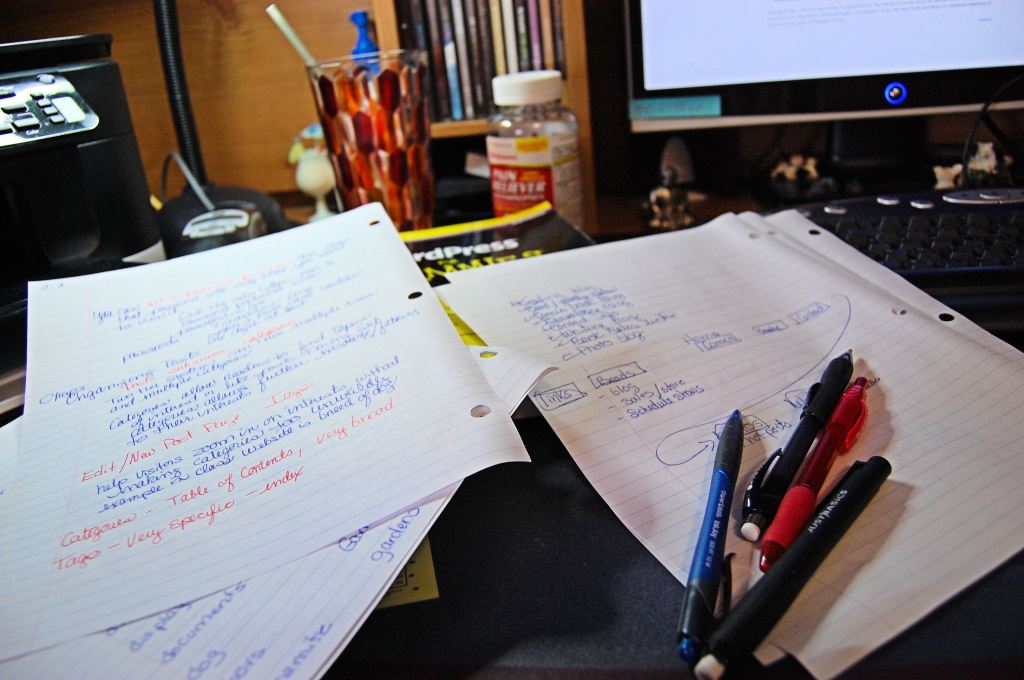
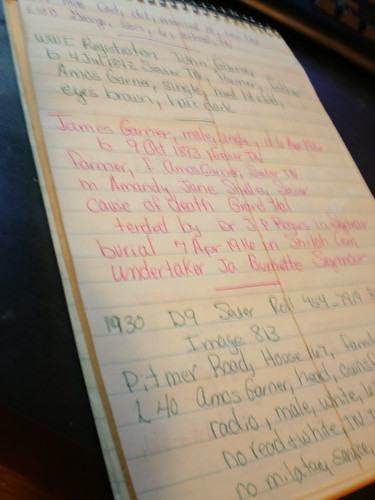
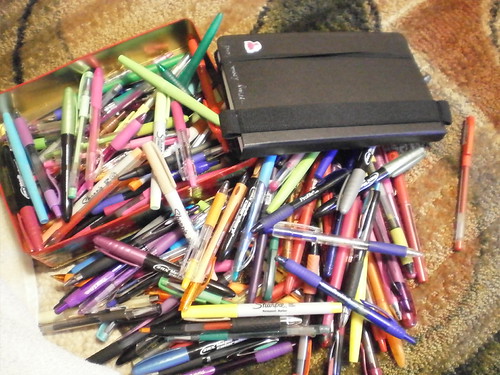
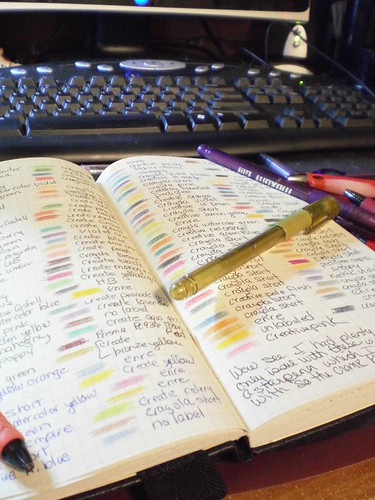
When making notes for genealogy I enjoy my vast collection of color ink pens. When I change sources or persons being researched I reach in and grab another color to make the notes.
Recently I’ve been playing in my pens with various color inks. I’m such an office supply slut, stationery slut, and pen slut it’s astounding. Any way, I’ve been doing some genealogy notes and to vary the entries as well as entertain myself I’ve been reaching into my giant stash of pens to change color from each person’s notes. It also serves to easily see when I changed sources or persons in a source. In the endeavor I’ve seen handwriting from the late 1700s to my own today. Which got me thinking…
My best friend and I were talking about how poor the handwriting from late teens to early twenty somethings has become. Now granted my penmanship on notes for me isn’t grand nor is it in my personal journal. But if I need to write to someone else I tend to make sure it’s legible, well proportioned, and attempt to be straight in my lines.
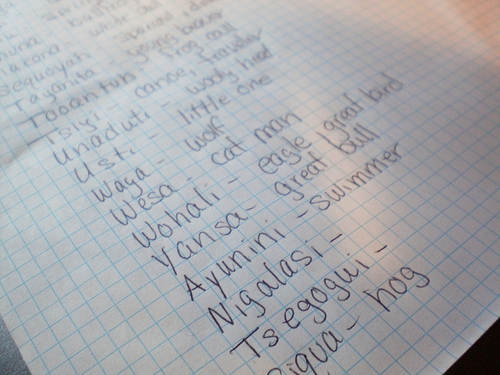
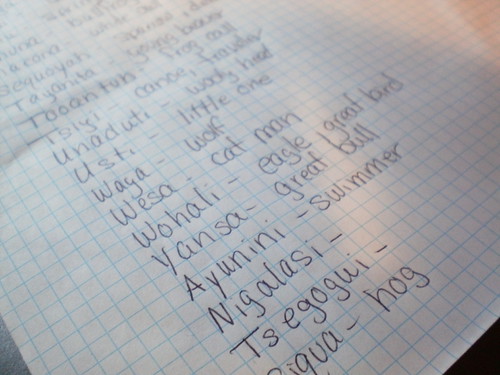
As I looked over my own handwriting samples for this entries photos I was surprised to see my notes when working on writing tasks (like researching Male Cherokee given names for a character) tend to be very decently formed block printing. Didn’t consciously make the choice but apparently my subconscious does. However when I’m flowing on plot ideas it’s chicken scratch cursive.
Here I was researching given names for Cherokee men and their meanings for a character.
So why does the younger generation’s handwriting look so awful to us? I think part of it is we were raised going to handwriting/penmanship class daily from Kindergarten through 8th grade. It is because of the work of my parents (mainly my Mom) and many frustrated teachers that I can now with effort write well in block print and cursive if I want to (or my subconscious wants to do it).
Somewhere between my attending those grades and my son attending those grades penmanship was no longer taught beyond here’s how you make the letters in print lesson for half a year in Kindergarten and a few years later here’s how you do it in cursive lesson for a quarter of a year.
This has been an issue with us since Aaron set foot in Kindergarten. It’s no longer taught how to hold a pen/pencil. When we’d correct his hamfisted grasp we’d be told his teacher said he could hold it any way he wanted. During parent teacher conference we were told this is true. Also we discovered penmanship wasn’t something that was even considered in grading for any course. Then again by fourth grade he was turning in word processed work. I thought maybe this was some progressive thinking of that school district but no it’s not. I’ve surveyed parents of children of similar ages and came away with the same answers. Not much writing is taught, even less concern is given to penmanship. Our kids don’t know how to do this well because we never taught them. (Lord knows I tried but TEACHER SAYS)
Sometimes recording those thoughts requires many colors of ink! LOL! I do enjoy pens that glide well or have unique ink.
The combination of not teaching penmanship and the use of keyboards for just about everything has caused the ability to form letters on the page in various styles to become a lost art. I’m not talking calligraphy here just basic writing. I have to admit I regret this. I’ve found so much joy in putting writing instrument to paper. I’ve thrilled at walking to the mailbox to get a handwritten message from a friend far away. I had pen pals from other states and countries all through middle school and high school. I’ve journaled most of my life. If I’m thinking out something I take pen to paper instead of clicking a keyboard. It’s how I get alone with my thoughts.
I’ve journaled most of my life. I go there to play on paper, record thoughts, sketch, doodle, plan, or whatever. Here I was playing with colored pencils and yes that’s a gold pen right there on top. Writes in gold too. OHH!
That’s changing. I should say that’s changed. Kids take notes on the laptops nowadays. They proof on the screen not on paper. They think things through, note reminders schedule activities, contact friends in faraway places all with a keyboard be it on a phone, connected to a cpu or on a tablet. No need to put pen or pencil to paper. It’s not their generation. They don’t judge one another by handwriting (admit it people over 40 you do, you judge lots by handwriting from education to emotional investment in the missive).
I’ve defended the younger generation and their keyboard usage. When a writing teacher said editing on paper was better I commented for us yes but those who have never turned in a handwritten paper in their life (and yes some are in grad school now can say that) working on the keyboard and screen is their life training. It’s a talent I still struggle to master – screen line edits. I do much better with a red pen and printed copy.
I’m fine with technical advancement. I remind myself when I see a new college grad with penmanship that would have gotten me a D in third grade that s/he will never hand write a thing for work or personal life for that matter. Yet I wonder if they know what they are missing. What would they do without electricity for say a month or so? It was six weeks after Hugo before I got electricity back. I could write checks and mail them (oddly the mail was the only service NOT interrupted). I could journal. I could write friends and assure them I’m okay and clean up is going well. I had pen, paper, and envelops.
Total dependence on keyboard or penmanship isn’t good. I think honestly there’s a good mix to be struck here. I think honestly as much as I hated penmanship classes. I was always a mediocre student in them. Yet now I find I’m thankful for the nine years of lessons. There is a joy to handwriting that I don’t want to be lost to those that are younger.
I’ve been writing all my life. Okay maybe not the first four or so years but MOST of my life. Those first four years I told stories to my parents well okay maybe not the first year or so. One story I told about a world renowned mouse is still remembered by my father as being as good as any of that mouse’s short movies he’s seen. But I didn’t start trying to write fiction stories to sell until about 10 years ago.
I had an idea for a novel (that has since broke my heart and is shelved indefinitely). Being a novice I tried to start responsibly. I signed up for a local class at the university. I passed the class with an A+ and was on my way to being a published novelist. Still not there yet – achieved the first part but not the second but still working.
In 1977 when I was in the 6th grade I was happy I had mastered outlining.
I had been introduced to the concept of outlining a novel before starting. Oh, I rebelled. I’d mastered those Roman numerals and letters back in junior high I wasn’t go back to them. So I did my first NaNoWriMo and finished it in two weeks. I had a novel, or so I thought. Except it wasn’t done and it took another 70,000 words to complete the story. It was too long and rambled (Gasp NO!).
I built a library of books on how to write. I read them all. I did exercise after exercise. I still refused this outlining idea. Who wanted to do all that proper spacing, deal with all those layers, take away the fun of following my muse where it leads you? NOT ME!
I again did NaNoWriMo. I again completed it in two weeks. I again had a large rambling mess of a story that at times was me at the keyboard desperate for words just going on and wondering how in the heck I was going to get the story from where it was to somewhere it needed to go.
Still the idea of outlining left me cold.
Then I took another writing class in my new town. There I met the core of what would become my writer’s group today. There I started writing short stories. There I got short stories published. There I mastered the structure of a story with practice and constructive critique.
There I learned outlining a story didn’t have to be that highly structured form I’d learned all those decades ago. It was a road map, a plan on how the story was going to get from the start to the end. It helped break down a large story into small doable daily chunks. I saw other writer’s outlines. One had published over 20 novels, I paid particular attention to what she wanted from an outline not so much how she did it.
I was learning writers are individuals. How each created a finished novel was individual. Sure I could learn from them but the answer was to take what I learned and create an approach that suited me. It was obvious my long rambling works needed structure. I could see an outline was structured. So how to take outlining’s structure without letting it box in this former regulatory compliance auditor. I did more reading seeking out books that talked about story structure and planning. I did more listening at the writer’s group on how they did it or how their approach was changing. Then one day I started and came up with an approach that’s still evolving but works well for me.
I was beginning to see the light on how a version of outlining could help me.
First I sit down with pen and paper. I think better in the old classic mode – pen to paper. I started writing out the outline of a story as if I was telling a friend over coffee what my new novel was going to be. The whole story in synopsis, over coffee. There I had it a start progressing to a middle that makes it to the end. Then I looked over the story and saw it needed a time line so I started planning out on those notes how time was moving in the story. Then I went back through that and with each time I put a place that part of story occurred. Well by the time I’d done all that my notes were getting messy so I moved to a keyboard and started looking at what I had.
I typed it all up nice and neat moving things where my arrows said they should be, putting in the time and place things occurred.
Now was time for a bit of research into the genre that the story fell into best. How long are their chapters? How many are typical? How many words total? What makes a good chapter? After getting info on this I digested it and made some decisions for myself. By now I’d read tonnes of books, gone to many classes, sat in my writer’s group for years, published a few stories, attend some conference. I had an idea of the creative and business side to what I wanted to do.
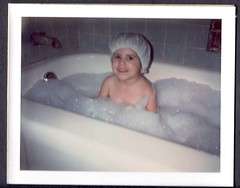
I’ve always gotten good ideas in the bath.
I decided to go with 30 – 35 chapters. Chapters were to be about 3,000 words give or take 500. I’d break up my outline into chapters and at the chapter break I’d put the time, place, and characters that were needed. When I was done I had my outline. It was compromised of chapter groups of about three sentences saying something like “John discovers diamond hidden in wall. Hearing bad guys coming he pockets it and runs.” So I knew the heart of the chapter, who had to be there, where it was and when it happened.
Writing from that became easier than sitting down with no idea what I was going to write beyond a number of words. My word counting days diminished. I wrote scenes or chapters. Sometimes I’d just to another place because a scene had just played itself before my mind’s eye in the shower. I get lots of ideas in the shower.
Now I have a map and mark my route from here to there in my story.
Now the outline isn’t set in stone but like a map it helps me plan how I’m going to go to get to my destination. As I write I make changes. On the printed copy I make notes of those changes. In the word document I make a note change starts here. Then I keep on writing as if the changes had always been there. Also my printed outline gives me a road map to where my changes are in that final first draft.
Now I’m to the next step. The first draft sets on the shelf cooling. The outline with notes has cooled over the holidays. Today I’ll take it out and look at the changes. I’ll work them in, typing up a clean copy of the revised outline that will guide my proofing and rewrite. Any more changes will be noted in the manuscript’s word document and on the outline for the next pass.
In the end I can say I solidly come down on the side of outline. I wouldn’t hit the road from here to say Seattle without a map of some kind. I might not take the route I first noted to Seattle but after I venture off to say find the diamond in the wall I know my choices of how to get heading in the direction of Seattle again and how to get there by the deadline.
As always I’d love to hear from you. You can comment here (it’ll show up when I get it) or you can can catch me over on Google+ (+Mary Louise Eklund) or on Twitter (@marylouiseklund) or on Flickr (Mary Louise Eklund). If those don’t suit you can e-mail me marylouiseeklund at either yahoo.com or gmail.com.
There are two things I’ve discovered people do when I tell them I’m a published author. They either tell me their great idea for a best-selling novel or they ask where I get my ideas. After encountering this over and over I asked more experienced authors about it. They assured me that’s common and I’d best get used to it. So for those who have ideas I urge them to write that novel! For those who wonder how published ideas form, here’s how I got inspiration for my latest short story.
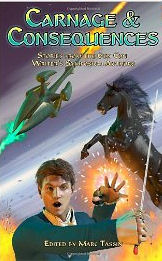
Starting next Wednesday, 4 Aug 2011, GenCon 2011 opens. With that is the release of Carnage & Consequences an anthology of short stories by GenCon authors. I was thrilled to be invited to submit a story for consideration. I’ve been attending GenCon for three years to hone my writing skills in their writer’s symposium. It’s the best advice for the most affordable price around even if you don’t write sci-fi or fantasy. I was beyond thrilled when the story was accepted! The story is “The Rider” a ghost story set on the French Broad river in the Appalachian mountains of Upper East Tennessee.
Both sides of my family can trace roots back in those mountains to land grants for service in the Revolutionary War. I grew up in those hills hearing family stories handed down for generations. When casting around for inspiration for a ghost story, my mind fell upon the tale of my 4th great-grandfather James Rolen. His death seemed one that would leave a restless lost spirit behind. From the family lore I spun a tale that hopefully tingles your spine and pulls on your heartstrings at the same time.
My 3rd Great Grandfather Joab Rolen son of the real James Rolen
What was family lore and what was story? First off, there have never been any reports I know of about a rider coming from the French Broad to take boys into the river to drown. There have been no tales of the ghost of James Rolen but there was the family lore of his death.
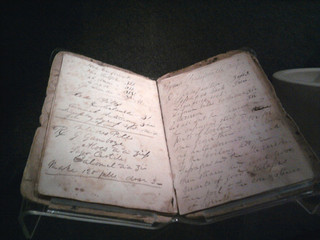
The story handed down through the family and recorded in the family Bible starts when James Rolen married Sallie Smith from South Carolina. He took her home to the family farm owned by “old man William.” They have a son born 07 Feb 1808 but Sallie wasn’t happy. She missed her family. James wanted to stay on the land because he was next in line to inherit. The marriage spilt. Sallie took little Joab to South Carolina with her.
Years pass, then by letter Sallie informs James she’s married a Mr. Gould. They intend to move out west. James agrees not to prosecute Sallie for bigamy if she’ll turn Joab over to him. Arrangements were to meet in Cosby, Tennessee during the early Spring of 1813. They met at the McMahan Inn, a familiar stop for those traveling west. There Joab was given to the father he didn’t remember. Sallie and Mr. Gould rode off for a new life in the west.
According to Elizabeth Anna McMahan the wife of Archibald McMahan the inn owner, James stayed a few days getting to know his son. During this time there were hard rains swelling the French Broad river. Time came that James felt he had to return to the east side of the mountain to assist in planting on the farm. Eliza Ann fretted with the two crossing the swollen river and pleaded for James to wait. He wouldn’t but a deal was made. He would leave Joab with the McMahans until his return after planting. Eliza Ann promised to take care of Joab as if he were one of her own.
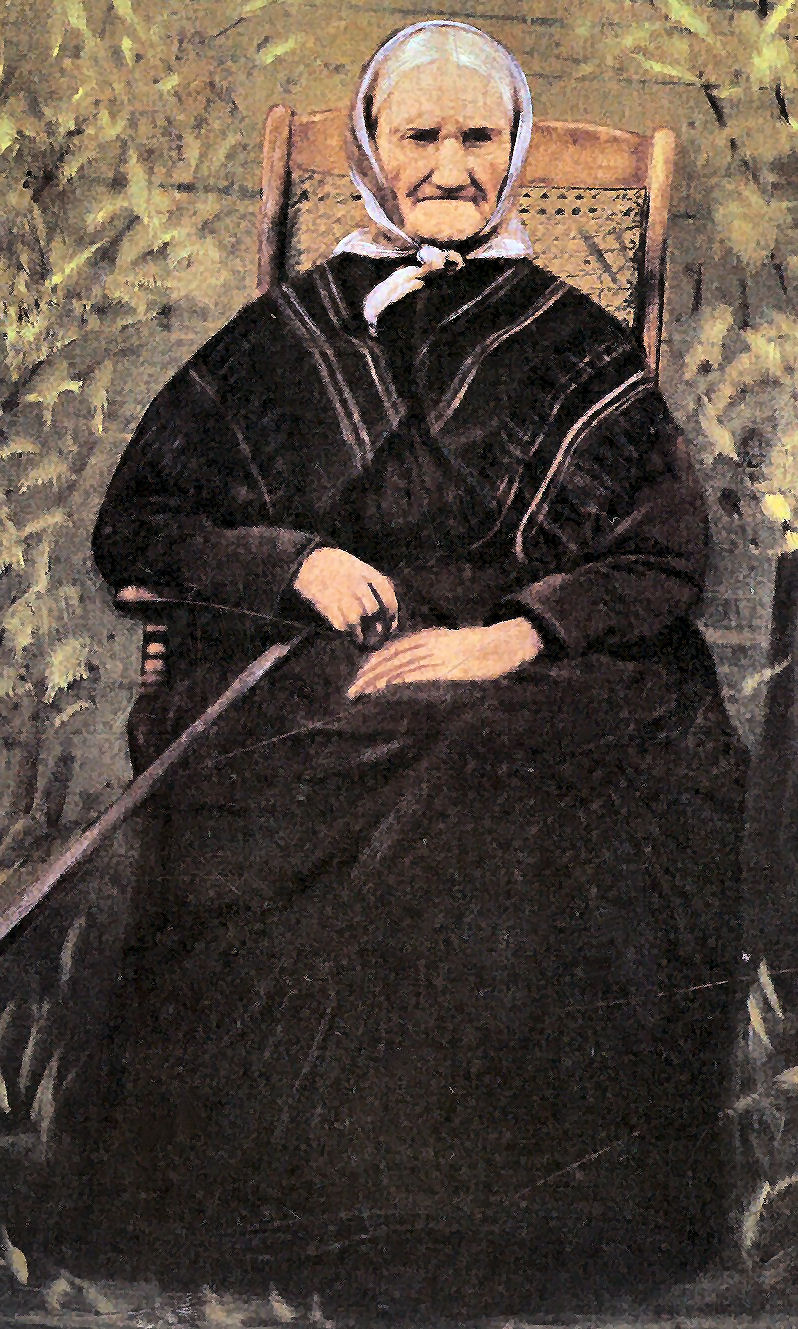
My 3rd Great Grandmother Anna McMahan Rolen wife of Joab Rolen
Her fears proved true. James and his fancy black stallion were caught in the river currents and swept away forever, drowned. Men from the community tried to save them to no avail. The McMahans weren’t sure of just where James had come from over the mountain or where Sallie was going out west. They had an orphaned boy on their hands. Good to her word Eliza Ann raised Joab as she did her children. She wrote down what she knew of James and Sallie keeping alive the memory of the father who wanted his son.
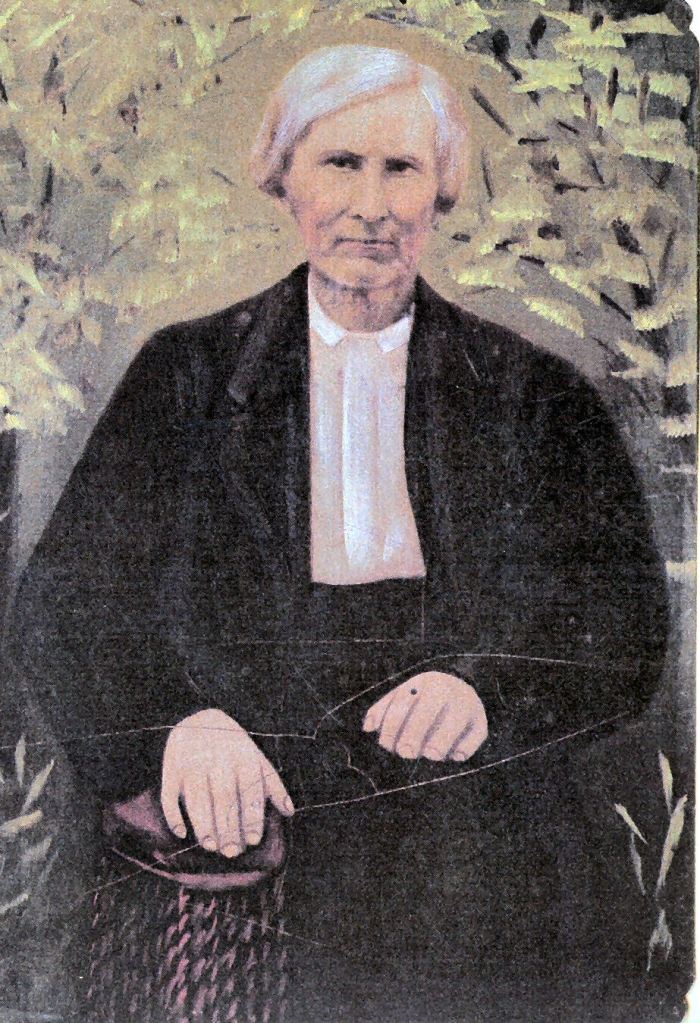
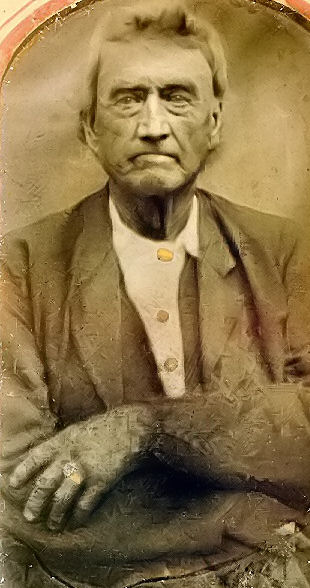
Joab married one of the McMahan’s daughters Anna. He became best friends her brother David. The two often entered into land deals together and became the largest land holders in Sevier County, Tennessee at the time. From this they became rich men, check out the gold buttons and diamond ring David paid extra to have painted on his photo included in the slide show above.
Joab and Anna had 10 children. One was named James in memory of Joab’s lost father. I’m descended from their son George Washington Rolen through my mother. He was sheriff of Sevier County Tennessee for many years. All their children were successes in many ways State Senators, businessmen, teachers, Post Masters, and preachers. Their stories are fodder for more posts and short stories at another time.
As a hobby genealogist I crave documentation. I’ve documented Anna and Joab’s marriage. His close relationship with her parents from their wills. His close relationship with David from the land transactions where they bought and sold land as partners. In David’s will Joab is highly regarded. However, when it comes to documentation James remains a mystery.
Sallie and her Mr. V. Gould settled in Indiana which was the west then. They had 7 children. I’ve not researched that lineage beyond that point.
David Crockett McMahan brother of Anna & best friend of Joab Rolen
I have tried hard to find James, my 4th great-grandfather. On the other side of the mountain from Cosby is North Carolina. However, the route to the McMahan Inn fed people from Virginia and South Carolina through the mountains to the west. Searching so far has given me some tantalizing leads to William Roland, possibly the “old man William” that James talked about to Eliza Ann and Arch McMahan?
So many questions are left unanswered. Was William a Rolen or from James’s maternal line? Was William his father or grandfather or possibly an Uncle? Where was this farm over the mountain that produced such a successful man whose fine clothes, saddle, and horse were noted by the Cosby residents that saw him? I’m afraid we don’t know. I continue my search to link that William Roland a Revolutionary soldier with a North Carolina land grant to a James Rolen born in the 1780s and married a Sallie Smith from South Carolina.
The man of mystery and his sad death inspired the ghost of my story “The Rider.” The people in the story are from my Appalachian roots, a feisty crone who knows more than she appears to at first glance, a boy living in a mountain cabin as the world changes from World War I. The divide between the lives of the mountain folk and those of the city dwellers. All ideas rooted in reality but spun into a tale.
That’s where I got this idea. There’s no predicting from where the next idea will come.
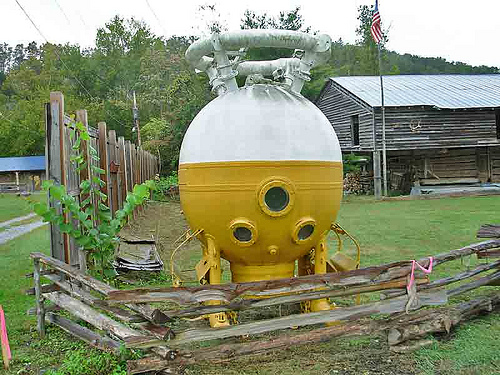
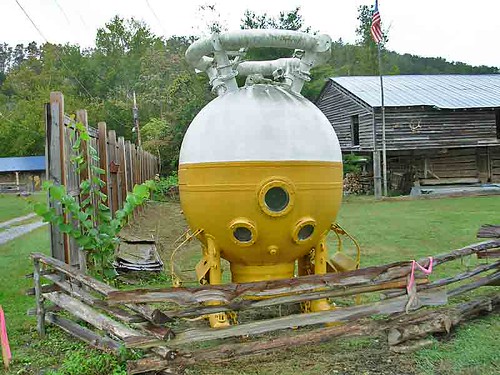
Bathysphere4826 by Bob Richmond on Flickr. Image used through the Creative Commons 2.0 Attribution license.
Welcome to the first post in my blog. I’m not real sure where to start. Do I jump in babbling about the topic that entertains me for the day? Do I introduce myself? Do I set a statement of purpose for the blog? Do I need a bathysphere to enter the blogosphere? Maybe a blogysphere?
Since I can talk about anything, I know I have the first one covered. That’ll mostly be what I do, jump into a one-sided conversation on something that strikes my fancy. It’ll become two way if you comment because I will reply.
That brings me to introducing myself. As the blog says, I’m Mary Louise Eklund. I wear a lot of hats in life. I’ll write about all of them here. I’m a published writer of short stories. I’ve been published in Terribly Twisted Tales and most recently Steam Punk’d. I have more in the works. I’ll shout out when they are coming out. Given that I’ll write here about writing, words, language, reading, and all the stuff related to that. What I like, what I find frustrating, my process, inspiration, blocks, and all the stuff I go through trying to write.
I enjoy photography as a hobby. You can see my photos on flickr, again under my name. The most recent ones appear on my sidebar. I’ve sold a few in my time. I even worked as a photographer for a bit in my undergraduate days. I like going out and making photos of things, not so much into photographing people. It’s not that I don’t like people, I love to watch people. I just like to take pictures of things because they don’t fret over how they look. It’s also easier to find stuff that’s willing to pose and release for publication isn’t an issue.
On the people topic, I am into genealogy as a hobby. I love the stories I find, the interesting facts, and the thrill of the hunt. I like trying to solve the puzzle of family lore or where did so-and-so end up. Like Mark Hicks my 3rd great uncle that went to the Confederacy in the Civil War when all the others in the family were Union. His brother was a Union Calvary officer. The family never welcomed Mark home and blamed him for turning in his brother-in-law who died in Andersonville. Mark wound up in Arkansas destitute and living on the dole. I found him. Those stories and the questions raised as I work through the information I have will show up here. I’ve even got a story inspired by my genealogical research and expect more to come from it.
I make jewelry. I do beading and am trying out resin pouring designs. I will eventually sell the stuff. I’ll link to that here when it’s up and running. I’ll chat about my working on it and other crafting. I crochet and take various courses in other things that hit my fancy. So far I’ve enjoyed fused glass, pottery, and precious metal clay working. You’ll get all about those things too.
I’m a family person. I’m a mom of a 17 year old who is in his senior year in high school. I’m a wife of a busy business man who is also an officer in the reserves. I’m also the only child of aging parents. I’m a person with chronic illness that’s manageable but not curable. I’m a pet parent, 3 cats and a dog. Those things I’ll keep to a minimum. If it involves another person I don’t want to say more than they are comfortable with sharing. I don’t want to whine and complain about health, there’s enough blogs made up of kvetching. However, I’m sure some off it will come through at times.
That takes care of introducing myself and what I’ll write about. What do I intend to do here? I’ll post regularly. My goal is at least weekly but hopefully more often. I’m sure it’ll depend on the ebb and flow of the other areas of my life.